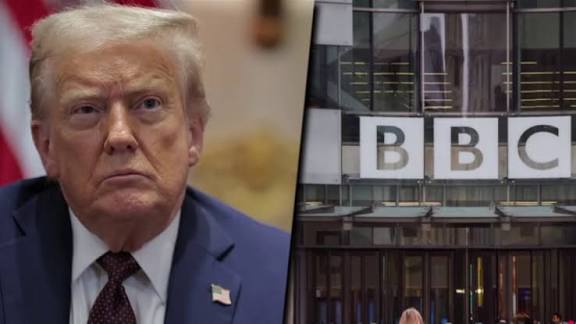
Trump Sues BBC for $1 Billion: When Editorial Manipulation Crosses the Line
Imagine watching a news program and later discovering that what you saw was deliberately distorted. Even worse: imagine that this distortion involved splicing together pieces of a speech separated by more than 50 minutes to create a completely different narrative.
This isn’t a conspiracy theory. It’s exactly what the BBC admitted to doing with a speech by President Donald Trump. And now, the British broadcaster faces a $1 billion lawsuit for its questionable editorial practices.
The Manipulation the BBC Can’t Deny
Let’s get straight to the facts, because they speak for themselves. In October 2024, the BBC’s Panorama program aired a documentary about the events of January 6, 2021, at the U.S. Capitol.
In this program, the broadcaster edited a Trump speech in such a way that he appeared to be directly inciting the Capitol attack. How did they do this? By joining two completely different parts of the speech that were originally separated by more than 50 minutes.
What Trump Actually Said
In the original speech, Trump said at different times: “We’re going to walk down to the Capitol and we’re going to support our brave senators and congressmen” and, much later, “And I’ll be there with you. And we fight. We fight like hell.”
The BBC took these separate segments and joined them together to make it appear that Trump was making a direct call to violence. This isn’t journalism — it’s pure and simple manipulation.
The BBC Itself Admits the Error
What’s most revealing about this case is that even the BBC can’t defend its own conduct. An internal memo that leaked last week exposed the problem, admitting that the program “misled the public.”
Additionally, BBC Chairman Samir Shah publicly acknowledged there was a “lapse in judgment” and that the editing created the impression of a “direct call to action.” When an organization admits to misleading the public, what other word can we use besides manipulation?
Over 50 Minutes Simply Erased
Think about this for a moment. Fifty minutes of context, explanations, and nuances were simply eliminated to create a narrative that fit the BBC’s editorial vision.
This wasn’t a simple “editing mistake.” It was a deliberate choice to distort reality to serve a specific agenda.
The Pattern of Institutional Bias
Perhaps you’re thinking: “Okay, it was an isolated error.” But it wasn’t. The leaked internal memo reveals a systematic pattern of problems at the BBC.
Michael Prescott, former independent adviser to the broadcaster’s editorial standards committee, documented a series of concerning issues, including anti-Trump bias, problems in Gaza coverage, and partiality on gender identity issues.
When Staff Members Themselves Blow the Whistle
The fact that these criticisms come from within the organization itself makes everything even more serious. Prescott isn’t an external critic with political motivations — he was there to ensure fair editorial standards.
When someone in that position denounces “systemic problems,” we’re not talking about occasional errors. We’re talking about a compromised institutional culture.
The BBC’s Inadequate Response
Now let’s examine how the BBC reacted to all this. The broadcaster received more than 500 complaints since the memo became public. Five hundred complaints is nothing to dismiss lightly.
And what was the initial response? The BBC tried to downplay the problem, claiming that the issue “had not generated a significant public response” when the program originally aired.
Sweeping It Under the Rug
This justification is particularly troubling. Essentially, the BBC is saying: “We didn’t do anything because nobody complained at the time.”
But the lack of complaints doesn’t make an unethical editorial practice acceptable. The duty of a journalistic organization is to maintain high standards regardless of whether or not there are public complaints.
Why Trump’s Lawsuit Is Legitimate
Some people argue that Trump is just trying to intimidate the free press. But let’s be honest: there’s a huge difference between legitimate criticism and deliberate defamation.
Trump’s legal team accuses the BBC of making “false, defamatory, derogatory, misleading, and inflammatory statements.” Considering the facts that the BBC itself admitted, these accusations seem quite well-founded.
Press Freedom Isn’t a License to Lie
It’s important to note that defending press freedom doesn’t mean accepting deliberate manipulation of facts. The free press exists to inform the public accurately, not to distort reality to serve an agenda.
When a media organization crosses that line, it needs to be held accountable. Otherwise, we set a dangerous precedent that major broadcasters can manipulate information without consequences.
The Resignations That Say It All
The gravity of the situation becomes even clearer when we look at the internal consequences. BBC News Director Deborah Turness resigned along with Director-General Tim Davie.
These weren’t planned departures or natural retirements. They were resignations under pressure, amid a growing scandal about the broadcaster’s credibility.
Taking Responsibility — Too Late?
Tim Davie said that “mistakes were made” and that he must “take ultimate responsibility.” This is admirable, but it raises an important question: why did these people only take responsibility after the scandal became public?
The problem had already been discussed internally in January and May 2025. Why wasn’t any significant action taken until the memo leaked?
The Impact on Journalistic Credibility
This case has implications that go far beyond Trump and the BBC. It affects how the public views journalism as a whole.
We live in an era when trust in media institutions is already low. When one of the world’s most respected journalistic organizations admits to deliberately manipulating a political speech, it hurts all honest journalists.
Who Pays the Real Price?
Ultimately, those who suffer the real consequences are news consumers — ordinary people who simply want to stay informed about what’s happening in the world.
When we can’t trust that major news outlets are presenting reality to us accurately, the entire society loses.
The BBC’s Weak Defense
Deborah Turness stated that the BBC “is not institutionally biased” and that “mistakes happen.” But this defense sounds quite hollow in light of the evidence.
When there’s internal documentation of systemic problems, when the broadcaster’s own staff denounce institutional bias, and when the manipulation is so clear that the organization itself can’t deny it, saying it’s “not institutional” seems more like damage control.
The Pattern Repeats
It’s worth mentioning that this isn’t the first case of editorial manipulation at major media organizations. In July 2025, CBS News reached a $16 million settlement with Trump after similar accusations of misleading editing.
When we see this pattern repeat across multiple organizations, it becomes hard to believe these are just “honest mistakes.”
Lessons That Need to Be Learned
This case should serve as a wake-up call for the entire journalism industry. Credibility is the most precious asset a news organization possesses, and once lost, it’s extremely difficult to recover.
Editors and producers need to understand that their responsibility isn’t to shape narratives, but to present facts accurately and in context. When they lose sight of this fundamental mission, they stop being journalists and become propagandists.
Accountability Is Essential
Trump’s lawsuit against the BBC, regardless of its final outcome, serves an important purpose: it establishes that there are consequences for deliberate manipulation of information.
Media organizations can’t expect to operate with total impunity, distorting facts and then simply apologizing when they get caught.
Conclusion: A Defining Moment for Journalism
This case represents more than a legal dispute between a president and a TV broadcaster. It represents a defining moment about the standards we accept in modern journalism.
The BBC made a serious error, admitted this error, but only did so after intense public pressure. This raises serious questions about how many other similar “errors” might be happening without the public’s knowledge.
Finally, if we want a free and respected press, it first needs to be an honest and accurate press. Manipulating speeches, joining segments separated by nearly an hour to create false narratives, and then trying to minimize the problem isn’t journalism — it’s propaganda.
Trump has every right to seek legal redress. And perhaps, just perhaps, this lawsuit will serve as a necessary reminder to the entire industry: the public deserves better.
What’s your opinion on this case? Should the BBC face more severe consequences? Share your thoughts in the comments!