
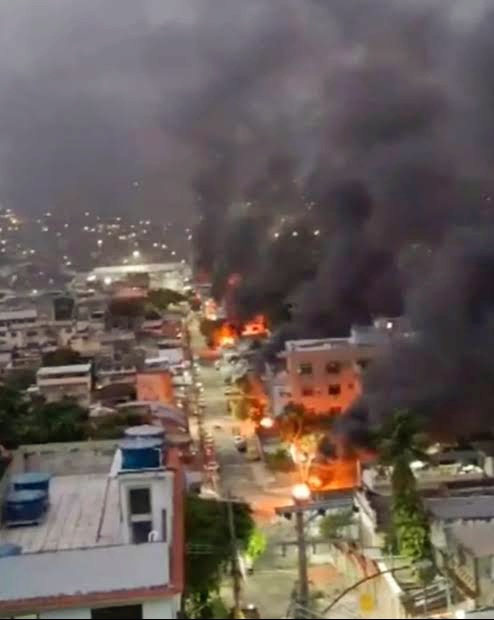
Rio de Janeiro Lives Through War Scenario with Over 60 Deaths While Federal
Rio de Janeiro woke up this Tuesday (28th) looking like a war zone. The massive police operation in the Alemão and Penha complexes resulted in at least 64 deaths, including four police officers, making it the deadliest operation ever recorded in the state’s history. Meanwhile, President Luiz Inácio Lula da Silva was in Malaysia, discussing trade agreements, apparently disconnected from the humanitarian tragedy unfolding on Brazilian soil.
What should have been a coordinated public security action became a symbol of the federal government’s structural failures in dealing with organized crime. Furthermore, the absence of federal support to the state of Rio de Janeiro exposes a profound contradiction: while the government criticizes betting sites and promises to combat violence, it proves unable or uninterested in taking effective measures when the situation demands concrete action.
The Deadliest Operation in Rio’s History
Operation Contenção (Containment) mobilized over 2,500 security agents with the objective of capturing 100 traffickers from Comando Vermelho (Red Command) and retaking control of areas dominated by the criminal faction. The planning took 60 days and involved officers from the Special Operations Command (COE), Military Police units, and various specialized Civil Police precincts.
Shocking Numbers
The operation’s numbers reveal the magnitude of the tragedy:
- 64 confirmed deaths, including 4 police officers
- 81 people arrested during the action
- Over 2,500 agents mobilized
- 28 schools closed in the Alemão Complex
- 17 schools closed in Penha
- 120 bus lines with altered routes
Therefore, we’re not talking about just a routine police operation. This is military action on national territory, with proportions that should have mobilized maximum attention from the federal government.
Criminals Use Drones to Launch Grenades
One of the most alarming aspects of the situation is the level of weaponry and organization of the criminal factions. Images released by the Civil Police show that criminals went as far as using drones to launch grenades at security agents.
“This is how Rio de Janeiro’s police are received by criminals: with bombs launched by drones. This is the size of the challenge we face. This is no longer common crime, it’s narcoterrorism,” declared Governor Claudio Castro (PL).
The Unacceptable Federal Government Omission
While Rio de Janeiro faced the worst day in its recent history in terms of urban violence, where was the President of the Republic? In Malaysia, discussing trade agreements and criticizing wars on other continents, apparently disconnected from the war happening in his own country.
Denied Requests for Help
Governor Claudio Castro revealed that he made three requests to borrow armored vehicles from the federal government, and all were denied. According to him, the justification was that this could only happen within a Guarantee of Law and Order (GLO) decree, and that “President Lula is against GLO.”
“We made three requests to borrow armored vehicles and all were denied,” Castro stated at a press conference. “They said it could only happen within a GLO, and the president is against GLO. Every time there’s a different excuse not to collaborate.”
Consequently, the state of Rio de Janeiro had to face alone one of the greatest threats to public security in Brazil’s recent history, without the federal support that would be not just desirable, but morally mandatory.
The Empty Speech in Malaysia: Blaming Drug Users
While Rio bled, President Lula gave speeches in Malaysia about world peace and humanism. “Who can accept the duration of the war between Ukraine and Russia? Who can accept the genocide perpetrated in the Gaza Strip?” the president questioned in his speech.
But the most serious part came when Lula addressed the topic of drug trafficking. In his speech, the president suggested that responsibility for the problem lies with drug users, not with public policies to combat narcotrafficking. “As long as there are people who buy drugs, there will be people who sell drugs,” he stated, transferring blame to consumers and ignoring the State’s omission in dismantling criminal organizations.
The irony is glaring: Lula expresses concern about violence on other continents and blames drug users for trafficking, but remains silent about the urban warfare happening on national territory. While he talks about humanism and peace abroad, families in Rio lived through hours of terror, trapped in their homes by gunfire, without access to hospitals or essential services.
The Government’s Contradiction About Betting Sites
The federal government’s omission in Rio’s security crisis gains even more problematic contours when we analyze the disproportionate attention that the Lula administration has given to other matters, such as regulating sports betting.
Inverted Priorities
In recent months, the federal government has dedicated considerable time and energy to regulating betting sites, even criticizing Caixa Econômica Federal itself for launching a betting platform. However, when it comes to fighting organized crime that controls entire territories and kills police officers with military-grade weapons, the response is silence and omission.
Furthermore, in recent speeches, government members have gone so far as to blame users themselves for the negative consequences of online betting, deflecting responsibility for effective public policies. This same logic of “blaming the individual” now seems to apply to public security: the government suggests that states should solve their problems alone, while it exempts itself from its constitutional responsibility.
Organized Crime as an Ignored National Problem
Comando Vermelho is not just a Rio de Janeiro problem. The criminal faction operates in several Brazilian states, with ramifications reaching Pará state, as revealed by the investigations that resulted in Operation Contenção.
A Transnational Threat
Investigations indicate that about 30 traffickers linked to CV operate in Pará state. This demonstrates that we’re dealing with a criminal organization of national reach, which requires a coordinated response at the federal level, not isolated actions by individual states.
Therefore, the federal government’s refusal to provide adequate support is not just a matter of political disagreement between different parties. It’s a structural failure in coordinating public security in a country where organized crime has long surpassed state borders.
Territory Under Criminal Control
Rio de Janeiro’s Secretary of Public Security, Victor Santos, revealed that the operation aims to correct a “disorder” of approximately 9 million square meters. About 280,000 people live in the 26 areas affected by criminal faction control.
“This is the state of war we live in Rio de Janeiro,” Santos said in an interview. “We deeply regret the injured people, but this is a necessary action, planned with intelligence, and it will continue.”
Faction Retaliation and Terror Among the Population
As expected, the mega-operation didn’t go without violent retaliation from Comando Vermelho. The criminals blocked several important city routes, turning the day into a nightmare for Rio’s population.
City Held Hostage
The main access routes in Rio de Janeiro were blocked by burned vehicles, including:
- Avenida Brasil – one of the city’s most important avenues
- Red Line – essential expressway
- Yellow Line – fundamental transportation corridor
Additionally, a public transportation bus was hijacked and used as a barricade, demonstrating the criminals’ complete disregard for the civilian population. Public schools and universities had to close their doors, and popular commerce centers remained inaccessible.
Impact on Health and Education
The Municipal Health Department reported that five Primary Care units couldn’t open, while others suspended home visits. In education, besides dozens of closed municipal schools, a state school also interrupted its activities.
Consequently, thousands of children were left without classes, families without access to healthcare, and workers unable to reach their jobs. The human and economic cost of this situation is incalculable.
The Political Battle and the Search for Scapegoats
As predictable, the tragedy in Rio quickly transformed into a political dispute between different government spheres. However, what should have been a moment of unity around a national problem became another episode of mutual accusations.
The Ministry of Justice’s Delayed Response
Only in the middle of the afternoon, after the situation had already become unsustainable and facing criticism from Governor Castro, did the Ministry of Justice and Public Security (MJSP) release a lengthy statement refuting the accusations.
According to MJSP, the ministry “has promptly attended to all requests from the State Government of Rio de Janeiro for the deployment of the National Force in the State.” The statement also claimed that “with significant investments and continuous efforts, MJSP remains committed to ensuring effective results.”
However, this response raises obvious questions: if the federal government was “promptly attending” to requests, why were three requests for armored vehicles denied? If there are “continuous efforts,” why did the state find itself alone in the biggest operation in its history?
Emergency Meeting Without the President
With the president still on his return flight from Malaysia, it fell to Vice President Geraldo Alckmin to convene an emergency meeting at the Planalto Palace. The meeting, described as “emergency in nature,” had the presence of several ministers but only happened after the worst had already passed.
As a result, the question remains: where was federal leadership when the planning for this operation was being done over the last 60 days? Why was it necessary to wait for 64 deaths for the federal government to deign to convene an emergency meeting?
The Arrests and an Uncertain Future
Despite the high cost in human lives, the operation resulted in the arrest of some important Comando Vermelho leaders. Among those captured is Nicolas Fernandes Soares, financial operator for Edgar Alves de Andrade, known as “Doca” or “Urso,” one of the faction’s bosses.
Important Captures
Also arrested was Thiago do Nascimento Mendes, known as “Belão do Quitungo,” identified as the leader of the Quitungo community. Weapons, motorcycles, and various communication radios used by criminals were seized.
However, questions arise about the long-term effectiveness of these arrests. Other criminals managed to escape through clandestine trails in the region’s forest, as recorded by police drones. The government is investigating whether there was information leakage about the operation.
The Endless Cycle
Rio de Janeiro’s history is marked by police operations that arrest criminal leaders, only to see them quickly replaced by other organization members. Therefore, without a long-term federal strategy that includes not just repressive actions but also social and economic investments in these areas, isolated operations tend to have limited effects.
The Discourse About “Living Conditions” as an Excuse
In previous statements about public security, President Lula has repeated a discourse that, while containing elements of truth, increasingly sounds like an excuse for inaction.
The Talk That Doesn’t Solve Anything
“We have a chronic problem of confronting organized crime. The truth is that as long as Brazilian people go hungry, as long as there’s a lot of unemployment and many abandoned people, there’s a possibility of organized crime growth,” Lula said on a previous occasion.
While it’s true that socioeconomic conditions influence criminality, this discourse has become a crutch to justify the lack of concrete actions in the present. The families who lived through Tuesday’s terror in Rio cannot wait decades until “living conditions” magically improve.
Furthermore, this type of rhetoric implicitly places blame on the poorest population, as if poverty automatically generated violent criminality. It ignores that millions of Brazilians in vulnerable situations daily choose the path of honesty and work, despite difficulties.
Comparison with Attention Given to Online Betting
The contrast between the attention the federal government dedicates to online betting and that dedicated to armed organized crime is, at minimum, disconcerting.
Energy to Regulate Bets, Omission to Fight CV
In recent months, the Lula government has:
- Issued ten ordinances to regulate betting sites
- Created a database to prevent Bolsa Família beneficiaries from betting
- Threatened to definitively end online betting
- Publicly criticized Caixa itself for launching a betting platform
- Blamed the users themselves for problems related to betting
Meanwhile, to fight criminal factions that control territories equivalent to the size of entire cities, the response is: deny armored vehicle loans, avoid decreeing GLO, and remain physically absent from the country during the biggest security crisis in years.
Recently in Malaysia: Blaming Drug Users
In his speech in Malaysia, while Rio was preparing for the mega-operation that would come days later, Lula made a statement that shocked many Brazilians. When speaking about narcotrafficking, the president stated that “as long as there are people who buy drugs, there will be people who sell drugs,” transferring responsibility for trafficking to drug users.
This posture of blaming the individual, ignoring decades of State omission in combating criminal organizations, reveals a worrying tendency of the government to exempt itself from responsibilities. Instead of presenting concrete strategies to dismantle Comando Vermelho and other factions, the president prefers to hold the population responsible for the problem.
Furthermore, this simplistic logic ignores the complexity of narcotrafficking as a national security problem, which involves international routes, money laundering, institutional corruption, and criminal organizations armed like armies. Blaming the end user is deflecting attention from the State’s real omission in its public security functions.
What Needs to Change Urgently
The tragedy in Rio de Janeiro exposes structural failures that demand immediate and long-term responses. There’s no more room for empty speeches and convenient omissions.
Necessary Federal Actions
The federal government urgently needs to:
- Create a national task force against organized crime, with Armed Forces participation when necessary
- Provide adequate equipment and resources to states facing armed factions
- Establish a long-term strategy that goes beyond isolated operations
- Invest in intelligence to dismantle organized crime’s financial networks
- Coordinate actions between states, recognizing that CV operates nationally
- Treat drug trafficking as a national security issue, not just a state matter
Furthermore, it’s essential that the President of the Republic demonstrate present and active leadership on these issues, not just speeches after tragedies have been consummated.
Final Thoughts: A Country Held Hostage by Omission
The operation in Rio de Janeiro, with its 64 fatalities, should not be normalized or accepted as inevitable. Each lost life represents a failure of the State to fulfill its most basic function: guaranteeing the safety of its citizens.
While the President of the Republic travels from continent to continent giving speeches about world peace and humanism, Brazilians live under the control of criminal factions armed with drones and grenades. While the government dedicates energy to regulating online betting and blaming users, it denies armored vehicles to police officers who risk their lives fighting narcoterrorists.
The contradiction is unsustainable. The omission is indefensible. And the Brazilian population, especially Rio’s, deserves much more than empty promises and speeches about “living conditions” while living under gunfire and blockades promoted by criminal organizations.
As a result, the question remains: when will the federal government treat public security with the same seriousness it treats betting regulation? When will it recognize that the organized crime problem requires presence, leadership, and action, not absence, speeches, and omission?
Rio de Janeiro deserves answers. Brazil deserves answers. And these answers need to come accompanied by concrete actions, not more international trips and emergency meetings after the worst has already happened.
What do you think about the federal government’s omission in this crisis? Share your opinion in the comments and demand from our representatives the attention this tragedy requires!
Sources and References:
https://maketruthtriumphagain.com.br/en/presidente-lula-enfrenta-novo-pedido-de-impeachment-focado-em-gestao-economica/