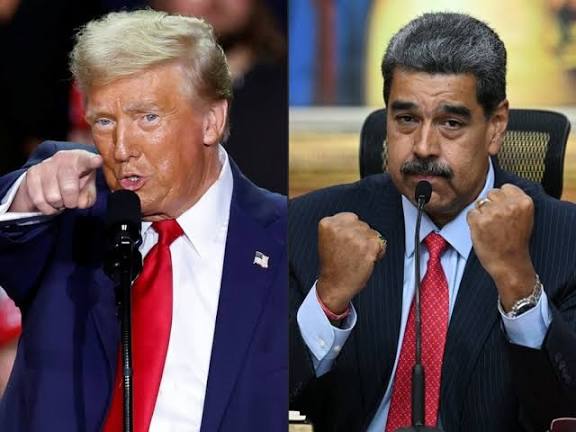
President Donald Trump once again linked the offensive to the repression of trafficking networks operating from Venezuelan territory.
Washington has expanded its military presence near Venezuela. The operation included warships, a nuclear submarine, F-35 fighter jets, and the strike group of the aircraft carrier USS Gerald R. Ford. This deployment reinforced the crackdown on organizations suspected of sending drugs to the United States. Within this context, President Donald Trump once again linked the offensive to the repression of trafficking networks operating from Venezuelan territory.
Trump’s Announcement
During a videoconference with members of the Armed Forces on Thursday, November 27, Trump declared that the U.S. will begin ground operations “very soon.” He explained that maritime routes had been significantly reduced and that the next focus would be neutralizing groups crossing borders by land. Furthermore, Trump emphasized that the government had already warned criminal organizations that the entry of illicit substances would not be tolerated.
The Military Context
The presence of the USS Gerald R. Ford and F-35 fighter jets symbolizes the increased military pressure by the U.S. in the region. In parallel, the deployment of a nuclear submarine reinforces Washington’s readiness to escalate its response. Therefore, the operation is not limited to maritime combat but also prepares the ground for land-based actions.
Regional Impact
The military escalation near Venezuela raises concerns among neighboring countries and international organizations. On one hand, the U.S. argues that the measure aims to protect its population from drug trafficking. On the other hand, critics warn of the risk of regional instability and potential direct confrontations. Thus, Trump’s announcement intensifies the debate on security and sovereignty in Latin America.
Final Reflection
Trump’s statement marks a new phase in the operation against international trafficking. Indeed, the reduction of maritime routes indicates initial results, but the challenge now will be confronting groups operating by land. Consequently, the Venezuelan case becomes an example of how foreign policy, national security, and the fight against organized crime intertwine on a global scale.
CTA: Want to explore more about international politics and security in Latin America? Discover other articles by Pedro Freitas and expand your critical perspective.