
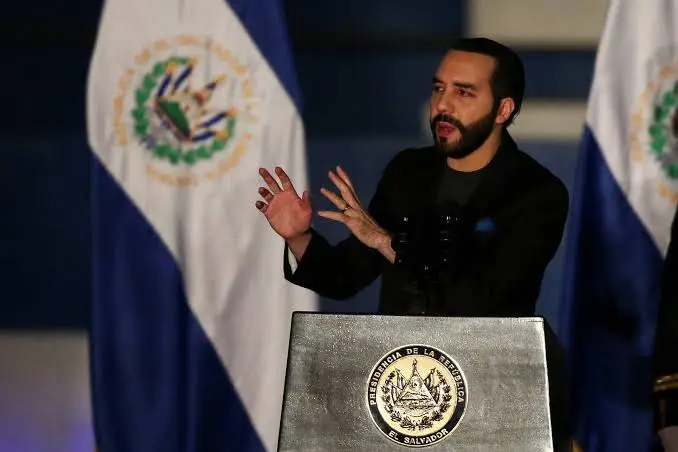
They Are in Government,” Says Salvadoran President, on Corruption in “Brazil.
The President of El Salvador, Nayib Bukele, has made bold statements about the state of public safety in Brazil and other Latin American countries. For the Salvadoran leader, who transformed his nation from one of the world’s most violent into one of the hemisphere’s safest, the explanation for the persistence of organized crime in countries like Brazil is simple yet alarming: criminal infiltration within government structures. Let’s explore Bukele’s arguments and analyze this controversial perspective on public safety in Latin America.
The Transformation of El Salvador: From Most Violent to Safest
Before delving into his critiques of Brazil, it’s important to contextualize El Salvador’s experience under Bukele’s leadership.
A few years ago, El Salvador faced one of the planet’s highest homicide rates. Gangs like MS-13 and Barrio 18 controlled vast territories, dictated rules in entire communities, and openly challenged state authority.
Bukele’s Strategy:
Since taking office, Bukele has implemented controversial yet effective measures, at least in terms of crime statistics:
- State of Exception: Temporary suspension of some constitutional guarantees to combat gangs
- Mass Arrests: Over 75,000 people have been detained in operations against criminal factions
- Mega-Prisons: Construction of maximum-security prisons with extremely harsh conditions
- Military Presence: Occupation of territories previously controlled by gangs
- Numerical Results: The homicide rate dropped dramatically, from over 100 to less than 3 per 100,000 inhabitants
These methods have drawn criticism from human rights organizations but have earned strong domestic support, with Bukele maintaining approval ratings above 90% in his country.
“The State Is Always Stronger”: Bukele’s Core Argument
The Salvadoran president’s fundamental premise is clear and straightforward: no government is structurally incapable of defeating organized crime.
Bukele invokes the concept of the “Leviathan”—a reference to philosopher Thomas Hobbes’ work, which describes the State as a supreme entity capable of maintaining social order through its legitimate monopoly on force.
The Logic of the Argument:
- Superior Resources: The State has budgets, equipment, and manpower far exceeding those of any criminal organization
- Legal Legitimacy: The government has the juridical and institutional backing to act against criminals
- Mobilization Capacity: It can coordinate police, military, and judicial forces simultaneously
- International Support: States can request cooperation from other countries to combat crime
For Bukele, if a government fails to control its territory, it’s not due to a lack of technical capacity or resources—it’s due to a lack of political will or, worse, complicity.
Brazil as an Example of State Inaction
Bukele didn’t hold back in his observations about Brazil, using the country as an example of a nation with all the necessary resources to defeat organized crime yet failing to do so.
Bukele’s Comparisons:
- Size of Organizations: Bukele acknowledges that factions like PCC and Comando Vermelho are much larger than Salvadoran gangs
- Disproportionate State Power: But he also highlights that the Brazilian State is incomparably stronger and wealthier than these organizations
- Territorial Control Paradox: He questions how gangs can control neighborhoods, favelas, and even entire cities while the government watches
Debunking Geographical Justifications
The Salvadoran president was blunt in refuting common arguments that justify the difficulty of combating crime in Brazil.
The Issue of Territorial Extent:
Many argue that Brazil’s continental size hinders effective state control. Bukele outright rejects this explanation.
Comparison with Canada:
Bukele cites Canada, a country with vast territory, including nearly inaccessible tundra, dense forests, and remote regions. Yet, there are no Canadian territories controlled by criminal organizations.
“Canada has impenetrable territories you can’t cross, tundra and all that, and there’s no one controlling a single piece of it.”
India and China:
Both countries have:
- Populations exceeding 1 billion inhabitants
- Extensive and geographically diverse territories
- Mountainous, desert, and forested regions
- Significant socioeconomic challenges
Yet, they don’t face situations where criminal factions establish territorial dominance comparable to Brazil.
The Amazon Forest Argument:
Bukele also challenges the justification that the Amazon hinders state control. His view is that other countries with equally challenging geographies manage to maintain sovereignty over their entire territory.
Rio de Janeiro: A Postcard Taken Over by Crime
The situation in Rio de Janeiro perfectly exemplifies Bukele’s point.
The Marvelous City, globally renowned for its natural and cultural beauty, has coexisted for decades with criminal factions dominating vast urban areas.
The Carioca Reality:
- Divided Territories: Different factions control specific communities, establishing invisible yet very real “borders”
- Informal Curfews: Favela residents often live under rules imposed by drug traffickers, not the State
- Parallel Economy: Billions of reais circulate annually in illegal activities, funding heavy weaponry
- Constant Shootouts: Gunfights are part of daily life, affecting schools, hospitals, and public transportation
- Compromised Basic Services: Electricity, water, internet—all are subject to faction oversight in dominated areas
The Paradox:
How can a city that hosts millions of tourists, stages major international events, and has one of the country’s best-equipped police forces have areas entirely outside state control?
For Bukele, the answer lies not in operational capacity but in the political will to truly address the issue.
The Most Serious Accusation: Criminals in Government
Bukele’s most provocative claim is his conclusion about why organized crime thrives in Latin American countries.
“How is it possible for a criminal organization to take over an entire territory and the government can’t remove them? Because they’re in the government, that’s why.”
What Does This Mean?
Bukele suggests that the persistence of organized crime isn’t due to incompetence but to systematic infiltration and corruption:
- Politicians Funded: Electoral campaigns receiving money from organized crime
- Corrupt Police: Officers protecting criminals instead of fighting them
- Bribed Judges: Judicial decisions favoring criminal organizations
- Leaked Information: Police operations pre-notified to targets
- Active Protection: Authorities effectively working for factions
The Controversy of Bukele’s Claims
It’s important to critically analyze these statements and recognize that they represent a specific viewpoint, not necessarily the full truth.
Valid Points:
- Real Corruption: Documented cases of police, politicians, and public officials linked to organized crime exist
- Lack of Priority: Many governments don’t treat public safety as a top priority
- Structural Issues: Systemic problems hinder effective action against factions
Questionable Points:
- Overgeneralization: Claiming all issues stem from corruption oversimplifies a much more complex reality
- Authoritarian Methods: Bukele’s success came at significant costs to human rights and constitutional guarantees
- Different Contexts: El Salvador and Brazil have vastly different socioeconomic and institutional realities
- Sustainability: It’s unclear whether Bukele’s results are sustainable long-term
Is the Salvadoran Model Replicable in Brazil?
The natural question arises: would Bukele’s tactics work in Brazil?
Challenges of Application:
- Population Scale: El Salvador has 6 million inhabitants; Brazil has 215 million
- Territorial Extent: El Salvador spans 21,000 km²; Brazil covers 8.5 million km²
- Institutional Complexity: Brazil has a federal structure with 27 autonomous states
- Prison System: Brazil already faces extreme overcrowding; mass arrests would drastically worsen the problem
- Constitutional Guarantees: Brazil’s Constitution imposes stricter limits on emergency measures
Ethical Questions:
Beyond practical challenges, there are important moral considerations:
- Is it worth sacrificing fundamental rights for the sake of security?
- How can we prevent emergency measures from becoming permanent?
- Who oversees concentrated state power?
- How do we ensure the innocent aren’t harmed?
Brazilian Experiences in Public Safety
Brazil has tested various approaches over the decades, with mixed results.
Examples of Policies:
- Military Occupation: UPPs in Rio aimed to reclaim territories with initial success but later deteriorated
- Federal Intervention: Temporary measures in states like Rio de Janeiro didn’t address structural issues
- Social Policies: Inclusion programs had limited impact on violent crime
- Tougher Penalties: Harsher laws haven’t significantly reduced crime rates
- Force Integration: Cooperation among different police forces showed results in specific operations
None of these isolated approaches have replicated El Salvador’s dramatic results.
The Role of Corruption in the Security System
While Bukele’s claim is controversial in its generality, it’s undeniable that corruption and criminal infiltration exist at various levels.
Documented Cases:
- Protection Rackets: Police charging drug traffickers to avoid crackdowns
- Weapon Diversion: Police equipment ending up in criminals’ hands
- Faked Operations: Leaked information allowing targets to escape before raids
- Bought Decisions: Judges and prosecutors influenced by crime money
These cases, though not representative of most security professionals, have a disproportionate impact on the fight against crime.
International Comparisons: What Works?
Looking beyond Latin America, we can identify successful strategies in different contexts.
Colombia:
Drastically reduced violence through:
- Systematic dismantling of cartels
- Massive investment in intelligence
- International cooperation (especially with the U.S.)
- Social policies in vulnerable regions
Singapore:
Maintains extremely low crime rates with:
- Severe punishments (controversial from a human rights perspective)
- Heavy investment in surveillance technology
- Strict social control
- Meritocracy and fierce anti-corruption efforts
Nordic Countries:
Combine security with rights through:
- Focus on rehabilitation, not just punishment
- Investment in education and opportunities
- Reduction of social inequality
- Community policing and proximity to the population
What Can Brazil Learn?
Regardless of whether one fully agrees with Bukele, his critiques offer points for reflection.
Possible Lessons:
- Real Prioritization: Public safety must be treated as a top priority with adequate resources
- Political Will: It’s necessary to confront entrenched interests, even when politically costly
- Anti-Corruption Fight: Without eliminating criminal infiltration in the State, other efforts have limited effectiveness
- Institutional Coordination: Police, judiciary, and governments need to work together
- Persistence: Lasting results require long-term commitment, not just temporary operations
Conclusion: A Necessary Debate on Public Safety
Nayib Bukele’s statements, though controversial, touch on painful issues that Brazil can no longer ignore.
The central question remains valid: why does a nation with resources, institutions, and technical capacity like Brazil allow criminal organizations to control territories and dictate rules to millions of citizens?
Whatever the answer—lack of political will, systemic corruption, complex structural issues, or a combination of all these factors—one thing is clear: the current situation is unacceptable.
Millions of Brazilians live under the yoke of criminal factions, deprived of basic rights, exposed to daily violence, and unable to fully realize their potential. Children grow up hearing gunshots, schools close due to clashes, and honest workers live between the fear of crime and the police themselves.
Bukele’s model may not be the complete answer for Brazil, but his experience shows that dramatic transformations are possible with genuine determination to tackle the problem.
The debate on how to achieve effective public safety—respecting fundamental rights and building sustainable solutions—must take center stage in national discussions. Because accepting the current situation as inevitable is, in fact, a choice—and a choice that condemns millions of Brazilians to live in a state of permanent war.
Interested in understanding more about the challenges of public safety in Brazil and possible solutions? Keep following our articles on politics, security, and the debates shaping the country’s future!
Sources:
Regional journalistic sources on political statements by Salvadoran authorities regarding corruption in Brazil.