
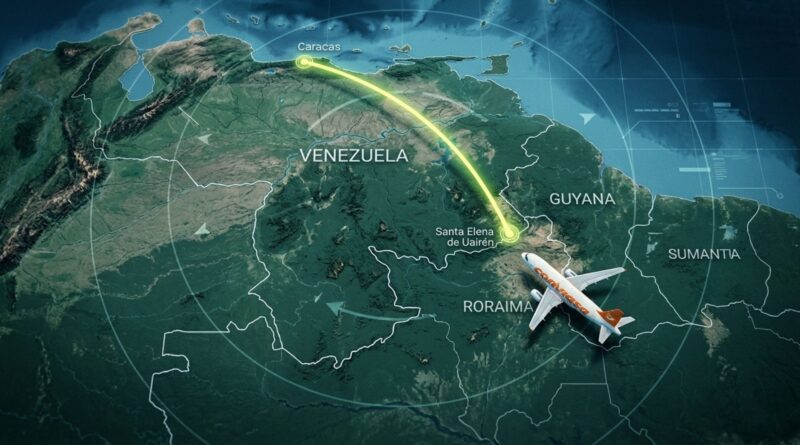
Maduro in Brazil? Venezuelan regime aircraft heads to the Brazilian border amid US siege.
An Airbus A319 (YV2984) operated by the Venezuelan state airline Conviasa, described as a “VIP government aircraft” and previously used by Nicolás Maduro, flew from Caracas to Santa Elena de Uairén, near the Brazilian border in Roraima, before returning to the capital. The movement comes as the United States intensifies military pressure in the Caribbean and President Donald Trump signals a possible closure of Venezuelan airspace and upcoming ground operations against alleged drug trafficking networks.
The Flight and Aircraft Status
According to tracking data from ADSB Exchange, the aircraft landed in Santa Elena de Uairén, about 10 km from the Brazilian border, and then returned to Caracas. The A319 YV2984 is part of the Venezuelan regime’s fleet and has been under U.S. sanctions since March 2020, listed by the Office of Foreign Assets Control (OFAC). This means the aircraft can be seized if it enters U.S. or allied territory. There is no evidence that Maduro was on board during the flight.
Brazil’s Position
Military and civilian sources confirmed that there is no information indicating Maduro’s escape into Brazilian territory. The Brazilian Army Command at the border stated it has not received any signals of the dictator’s movement toward Brazil. The Foreign Ministry, Federal Police, and Defense Ministry were contacted but have not yet issued official statements.
U.S. Pressure and Caracas’ Response
Trump declared that airlines, pilots, and criminal networks should consider Venezuelan airspace completely closed. In response, Venezuelan Foreign Minister Yván Gil condemned the measure as a “colonialist threat” and an “illegal act of aggression” against national sovereignty. The FAA recently warned major airlines of a “potentially dangerous situation” when flying over Venezuela, citing worsening security conditions and increased military activity.
Regional Consequences
The incident heightens uncertainty along the Brazil–Venezuela border, particularly in Roraima, a sensitive area for migration flows and logistics. A closure of Venezuelan airspace or additional sanctions could disrupt commercial, humanitarian, and transport routes in the region. Meanwhile, rhetoric about ground operations and the crackdown on drug trafficking raises the risk of incidents and diplomatic escalation.
What to Watch Next
- Air activity: new Conviasa flights (YV2984 and other sanctioned aircraft) toward border zones.
- Brazil’s stance: official notes from the Foreign Ministry and Defense on coordination with FAA and neighboring countries.
- U.S. measures: formalization of airspace closure, interdictions, and secondary sanctions on operators.
- Caracas’ response: impact on foreign airline authorizations and potential diplomatic retaliation.
CTA: Want to follow the developments at the border and the geopolitics of the Caribbean? Discover other articles by Pedro Freitas and expand your critical perspective.
Credits: Flight tracking via ADSB Exchange; reports from CNN Brasil; statements from U.S. and Venezuelan authorities.
Pingback: Trump Issues Ultimatum to Maduro: “Incalculable Consequences”