
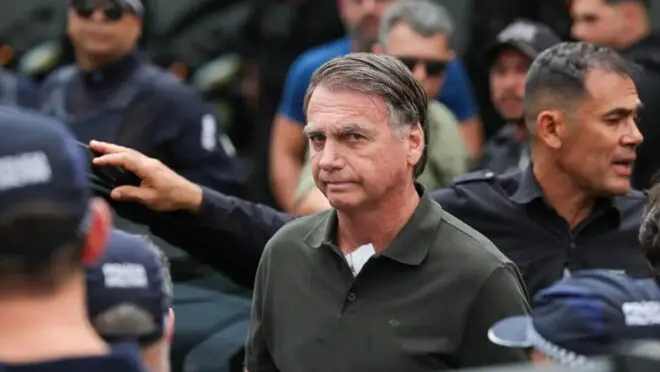
Bolsonaro’s arrest: a maneuver to quell simultaneous crises
The arrest of former president Jair Bolsonaro, carried out amid intense political turbulence, has been interpreted by several lawmakers and journalists as part of a broader strategy to shift public focus away from other scandals and institutional crises. In this context, the measure allegedly served to overshadow the failure of COP 30, the Banco Master scandal — which includes mentions of Justice Alexandre de Moraes’s wife — and, at the same time, reduce pressure on the controversial amnesty agenda. Federal deputy Sóstenes Cavalcante revealed in an interview with Revista Oeste that the Speaker of the House had made threats related to this issue, adding weight to the political interpretation.
The Failure of COP 30
According to analyses published in both national and international outlets, COP 30 ended without concrete progress on climate commitments. Furthermore, critics argued that Brazil lost diplomatic protagonism in environmental negotiations. In this scenario, Bolsonaro’s arrest dominated headlines, redirecting public and international attention toward domestic legal and political disputes.
Banco Master and Sensitive Connections
Lawmakers and journalists also highlighted the ongoing repercussions of the Banco Master scandal. The Compliance Zero operation uncovered evidence of fraudulent management and organized crime. In this context, mentions of indirect links involving Alexandre de Moraes’s wife intensified institutional discomfort. Therefore, Bolsonaro’s arrest functioned as a smokescreen, reducing the immediate impact of these revelations.
The Amnesty Agenda and the Chamber of Deputies
Another point raised by lawmakers is the controversial amnesty agenda, which divides political bases and places the Speaker of the House under pressure. Journalists recalled that lawsuits involving the Speaker’s mother increased his political vulnerability. Consequently, by placing Bolsonaro at the center of attention, the amnesty debate temporarily lost momentum, giving the Chamber’s leadership time to reorganize its strategy. In this sense, the revelation made by Sóstenes Cavalcante reinforces the perception that explicit threats were tied to the issue.
Political Interpretations
It is important to note that these readings do not represent consensus but rather political interpretations voiced by lawmakers and journalists. For some analysts, Bolsonaro’s arrest was an institutional response; for others, it fits into a pattern of strategic use of the judiciary during moments of multiple crises.
Critical Conclusion
Bolsonaro’s arrest, viewed through the lens of parliamentary statements and journalistic analyses, cannot be separated from the broader context: the failure of COP 30, the Banco Master scandal, and the amnesty agenda. Thus, the episode reveals how simultaneous crises can be politically managed through judicial actions with strong media impact. The key question is whether this strategy will have lasting effects or merely postpone inevitable debates.
CTA: Want to understand how political crises intertwine in contemporary Brazil? Discover other articles by Pedro Freitas and deepen your critical analysis.
Sources:
- Revista Oeste – statement by Sóstenes Cavalcante
- Bloomberg
- O Globo
- G1
- Reuters
- DW
- Veja
- Metrópoles
https://maketruthtriumphagain.com.br/en/joesley-batista-in-caracas-the-brazilian/