
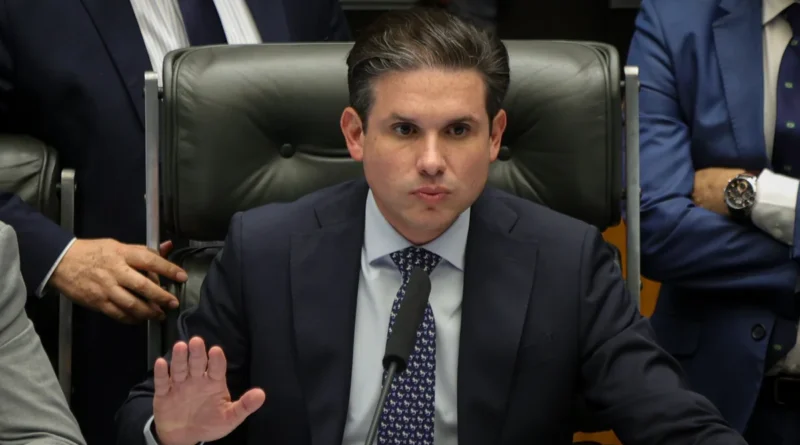
Hugo Motta Abdicates the Autonomy of the Chamber in Favor of the Supreme Court
End-of-Year Decisions
The President of the Chamber of Deputies, Hugo Motta (Republicanos-PB), recently announced a series of measures to “clear the agenda” before 2026. Among them, the revocation of the mandates of Eduardo Bolsonaro (PL-SP) and Alexandre Ramagem (PL-RJ). According to Motta, these decisions would prevent judicial disputes from contaminating the legislative calendar in an election year. However, the way they were taken exposes a serious institutional problem.
Revocation Without Plenary
In the case of Ramagem, sentenced to 16 years in prison, Motta decided on the revocation directly through the Board of Directors, without a plenary vote. According to him, the measure sought to avoid “new institutional stress with the Supreme Court.” Thus, the Chamber gave up exercising its constitutional prerogative to decide on parliamentary mandates. Consequently, the Legislative subordinated itself to the Judiciary, configuring an act of political prevarication.
The Dosimetry Bill
At the same time, Congress approved the Dosimetry Bill, which could benefit defendants of January 8, including Jair Bolsonaro. However, Motta declared that “the Supreme Court will decide case by case who will be entitled to the benefit.” Therefore, even after legislative approval, the President of the Chamber transferred to the Supreme Court the competence to apply or not the law. In other words, the Legislative renounced its role of defining general rules and left the Judiciary as the exclusive arbiter.
Institutional Submission
These attitudes reveal a posture of submission of the Legislative to the Supreme Court. By abdicating from putting decisions to a plenary vote and by declaring that the Supreme Court will decide on the application of an approved law, Motta weakens the independence of the Chamber. Consequently, the balance between powers breaks down and the Legislative loses its function as a counterweight. Thus, prevarication manifests itself not only as omission but as deliberate surrender of constitutional prerogatives.
Political Impacts
The episode generates distrust about the autonomy of Congress and reinforces the perception that the Supreme Court concentrates powers beyond its original function. In addition, it sets a precedent for future legislative decisions to be conditioned on judicial approval. Therefore, the Motta case is not just an administrative issue but a warning sign for Brazilian democracy.
Critical Conclusion
By revoking mandates without plenary and by transferring to the Supreme Court the application of an approved law, Hugo Motta committed an act of institutional prevarication. Thus, the President of the Chamber renounced the constitutional right of the Legislative and reinforced the supremacy of the Judiciary. Consequently, the episode exposes the fragility of the separation of powers and puts Brazil’s democratic balance at risk.
CTA: Want to understand how the abdication of legislative prerogatives threatens democracy? Explore other articles by Pedro Freitas and keep your critical eye on Congress and the Supreme Court.
Sources:
- Metrópoles – statements by Hugo Motta on revocations and dosimetry
- Legislative documents and analyses on the balance of powers
Bank Master Under Investigation: PF Probes Vorcaro for Secret Files and Hacker Links
Pingback: Alexandre de Moraes and Banco Master: Political Pressure, Conflict