
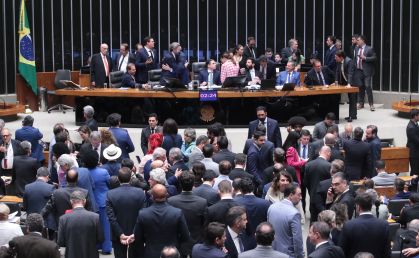
Amnesty, Impeachment and Congress’s Omission: The Lack of Courage to Defend Democracy
What Was at Stake
The National Congress began discussions on a broad, general, and unrestricted amnesty for defendants involved in the January 8 events. The proposal initially gathered enough votes to move forward but was quickly suffocated by pressure from the Supreme Federal Court (STF), which signaled it would declare the measure unconstitutional and instead impose a dosimetry framework. This stance, beyond invading the exclusive competence of the Legislature, reveals an even more serious political objective: to block Jair Bolsonaro’s candidacy from the electoral arena, even at the cost of violating the human rights of hundreds of individuals who remain imprisoned or prosecuted under questionable conditions.
The Omission of Deputies and Senators
Despite having constitutional instruments to confront judicial abuses, such as the impeachment of Supreme Court justices provided by Law 1.079/1950, deputies and senators prefer to hide behind speeches and half-measures. Their lack of courage to expose their mandates and confront the STF creates institutional paralysis:
- Systematic shelving: dozens of impeachment requests against STF justices remain stalled in the Senate, never read in plenary.
- Political fear: lawmakers avoid addressing the issue to avoid conflict with the Judiciary and the media, sacrificing their oversight role.
- Unrealistic expectations: speeches about “Christmas release” or “immediate amnesty” create false hopes, knowing the legislative process and STF resistance make them impossible.
The STF’s Role and Institutional Contradiction
By declaring in advance that an amnesty would be unconstitutional, the STF oversteps its role as guardian of the Constitution and assumes the position of a negative legislator. This posture generates two contradictions:
- Violation of separation of powers: the STF cannot prevent Congress from voting on a legitimate proposal.
- Legal incoherence: declaring unconstitutional a political decision before its approval has no legal basis.
More than that, the STF’s stance makes clear that there is a political calculation underway: to neutralize Jair Bolsonaro as a candidate, even if it means sacrificing the fundamental rights of hundreds of citizens. The logic is simple and perverse: keep defendants imprisoned and processes open to sustain the narrative of a threat to democracy, while preventing the political participation of a major adversary.
Pavinatto and Impeachment as the Ignored Solution
Jurists such as Tiago Pavinatto remind us that impeachment of STF justices is the constitutional mechanism to restore balance among the powers. Law 1.079/1950 clearly defines crimes of responsibility and the procedural steps, but the Senate insists on ignoring its application. This omission turns impeachment into a political taboo, when it should be the legitimate tool to confront abuses.
Critical Conclusion
The amnesty debate shows how Congress bows to the STF out of fear of exposing their mandates. Deputies and senators prefer easy speeches and unrealistic promises rather than confronting the core problem: the hypertrophy of the Judiciary and the absence of accountability for its justices. Meanwhile, the STF advances over legislative competences, declaring unconstitutional what it cannot block and using this power to remove Jair Bolsonaro from the electoral race. Brazilian democracy remains weakened, not for lack of instruments, but for lack of political courage.
CTA: Want to understand how impeachment can be used to restore balance among the powers? Explore other articles by Pedro Freitas and deepen your critical analysis of Congress and the STF.
Sources:
- Brazilian Senate – Official News
- Brazilian Chamber of Deputies – News
- Consultor Jurídico – Analyses on amnesty and impeachment
Flávio Dino and the Curtailment of Defense: Filipe Martins’ Lawyer Removed from the STF Podium